- Community
- Discord(JEE)
- Telegram(JEE)
- Similar Resources
- All Chemistry Books
Best Book for Organic Chemistry for JEE 2027 (Main & Advanced)
Last Updated: October 2026 · Editions checked 24 October 2026
The best organic chemistry books for JEE are NCERT Class 11 and 12 for the base, M.S. Chouhan's Advanced Problems in Organic Chemistry for practice, and Solomons, Fryhle & Snyder's JEE edition if you need a theory book. For JEE Main alone, NCERT plus M.S. Chouhan's Elementary Problems and past papers is enough.
Our picks at a glance
| Use it for | Book | What it is | Level |
|---|---|---|---|
| Base for everyone | NCERT Class 11 & 12 (Part 2) | Theory + basic questions | Main + Advanced |
| Theory (self-study) | Solomons, Fryhle & Snyder for JEE | Theory, mechanisms | Advanced |
| Simpler theory | O.P. Tandon Organic | Theory | Main |
| First practice | M.S. Chouhan Elementary Problems | Questions with solutions | Main |
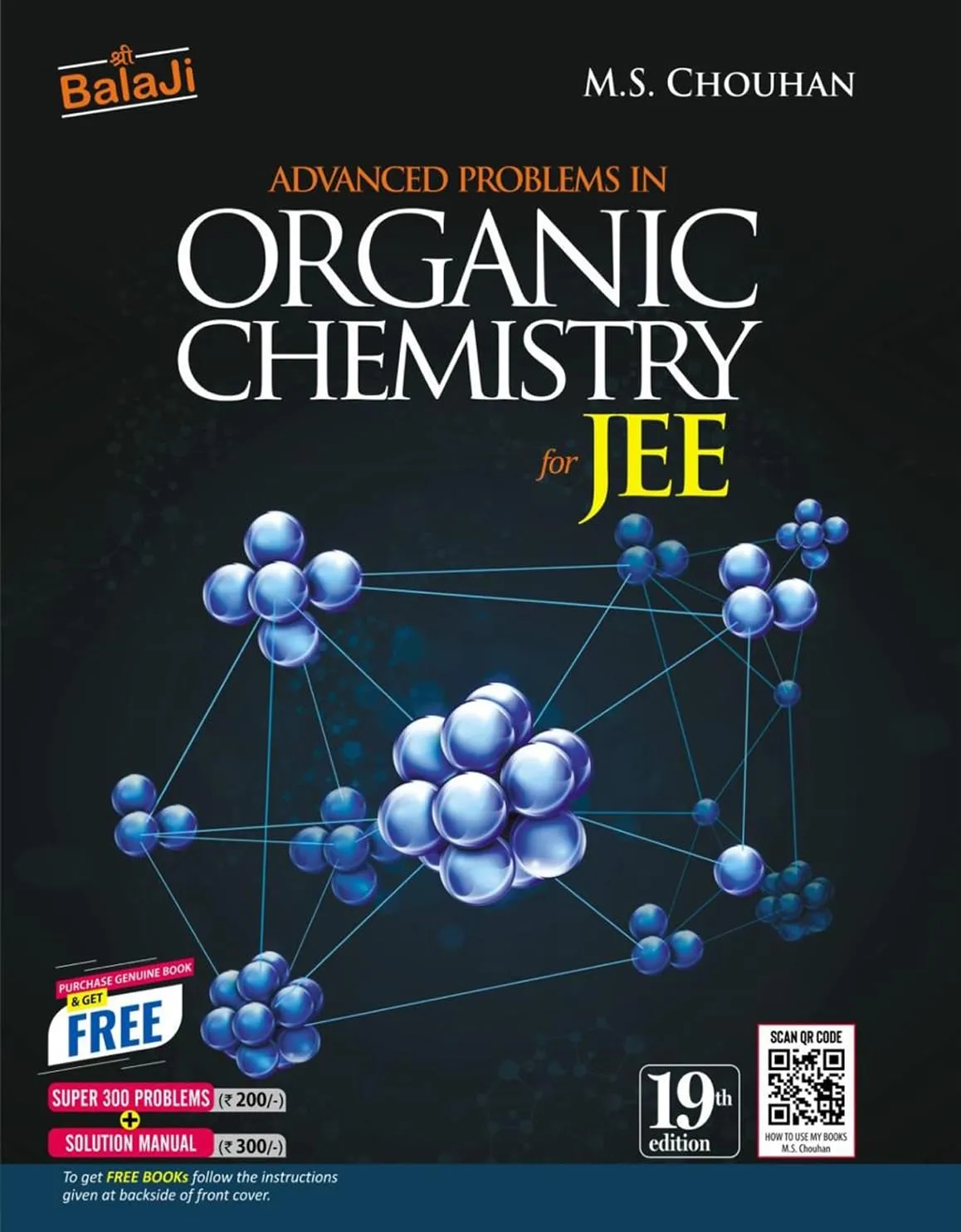
| Best practice book | M.S. Chouhan Advanced Problems | Questions with solutions | Advanced |
| Alternative to Chouhan | Himanshu Pandey Advanced Problems | Questions with solutions | Advanced |
| Optional | Peter Sykes, Guidebook to Mechanism | Mechanisms only | Advanced |
One theory source and one problem book per branch, finished completely, beats five books started. So every pick below says what it is for, and when it is not worth buying.
The best organic chemistry books for JEE, explained
Which books should you use? Pick by your goal
JEE Main only
NCERTthenM.S. Chouhan ElementarythenJEE Main PYQs
Skip polymers and chemistry in everyday life: they are not in the JEE Main 2026 syllabus.
Main + Advanced, with coaching
Coaching notes + NCERTthenM.S. Chouhan ElementarythenM.S. Chouhan AdvancedthenJEE Advanced PYQs
Himanshu Pandey can replace M.S. Chouhan Advanced. Keep Solomons as a reference only.
Self-study, no coaching
Solomons for JEE or O.P. TandonthenNCERT reactionsthenM.S. Chouhan ElementarythenM.S. Chouhan Advanced
Read the theory chapter first, then solve that chapter's problems the same week.
Dropper, 6–8 months left
Your notes + NCERTthenM.S. Chouhan AdvancedthenPYQs
Don't start a new theory book now; one problem book and past papers are enough.
What the 2026 syllabus changes for your books
The JEE Main 2026 syllabus (NTA) has 20 chemistry units and no longer includes states of matter, solid state, surface chemistry, s-block elements, hydrogen, metallurgy, polymers, environmental chemistry or chemistry in everyday life. Most books still print those chapters. If you are writing only JEE Main, skip them. JEE Advanced 2026 still includes all of them (its syllabus is unchanged from 2025), so Advanced aspirants should keep them.
The order to study organic chemistry
GOC is the whole game. Inductive and resonance effects, hyperconjugation and carbocation/carbanion stability decide almost every later answer. Do it first and do it slowly, then isomerism (structural and stereo), then hydrocarbons, then halides, alcohols/phenols/ethers, carbonyl compounds and acids, amines, and finally biomolecules.
For each chapter: theory (class notes or Solomons) → NCERT reactions → solve the problem book for that chapter → that chapter's PYQs. Keep a single reaction sheet per chapter and a list of reagents (what each one does), and revise them weekly; organic is forgotten fastest of the three branches.
Books you can skip
Clayden and Morrison & Boyd are excellent university textbooks, but far longer than JEE needs. Doing M.S. Chouhan and Himanshu Pandey together rarely adds marks; pick one. Several theory books at once is the most common way students never finish organic.
Practise with real JEE papers
No book replaces past papers. Once a chapter is done, solve its questions from the official JEE Main 2026 papers and answer keys and, for Advanced, the official JEE Advanced papers 2015–2025. Also see the best physical chemistry book and best inorganic chemistry book guides, and all chemistry books for JEE.
How we chose these books
We matched each book against the official NTA JEE Main 2026 syllabus and the JEE Advanced 2026 syllabus, checked what students and teachers consistently recommend across forums and coaching advice, and confirmed the latest edition of each book on Amazon India on 24 October 2026. We don't rank books by commission; links to Amazon are affiliate links that support this free site at no cost to you.
Frequently Asked Questions about Organic Chemistry Books for JEE
Which is the best book for organic chemistry for JEE?
For most students: NCERT for the base and M.S. Chouhan's Advanced Problems in Organic Chemistry for practice. Add Solomons, Fryhle & Snyder's JEE edition if you need a theory book because you study without coaching.
Is NCERT enough for organic chemistry in JEE Main?
NCERT is enough for the theory JEE Main asks, but not enough practice. Add one problem book, M.S. Chouhan's Elementary Problems, and solve JEE Main past papers.
Which is better for organic: M.S. Chouhan or Himanshu Pandey?
Both are good JEE Advanced problem books at a similar level. M.S. Chouhan is the more widely used. Choose one and finish it rather than doing both.
What is the best theory book for organic chemistry for JEE?
Solomons, Fryhle & Snyder's JEE edition (Wiley) explains mechanisms best. O.P. Tandon's Organic Chemistry is simpler and enough for JEE Main.
Is Solomons necessary for JEE?
No. If your coaching notes explain mechanisms well, NCERT plus a problem book is enough. Solomons helps students who study on their own or find mechanisms confusing.
When should I start M.S. Chouhan's Advanced Problems?
After you have finished a chapter's theory and solved the easier questions on it. Start with GOC and isomerism, which every later chapter depends on.
Support Our Mission
By purchasing through the links below, you help us keep JEE Archive running at no extra cost to you. We receive a small commission from amazon, which directly support the maintenance and growth of this platform.