- Community
- Discord(JEE)
- Telegram(JEE)
- Similar Resources
- All Chemistry Books
Best Book for Inorganic Chemistry for JEE 2027 (Main & Advanced)
Last Updated: October 2026 · Editions checked 24 October 2026
The best inorganic chemistry book for JEE is NCERT Class 11 and 12: JEE Main inorganic questions come mostly from it. Add V.K. Jaiswal's Problems in Inorganic Chemistry for practice and, for JEE Advanced, Wiley's J.D. Lee for JEE (Sudarsan Guha) to understand the reasons behind the facts.
Our picks at a glance
| Use it for | Book | What it is | Level |
|---|---|---|---|
| The main book | NCERT Class 11 & 12 | Theory, facts, tables | Main + Advanced |
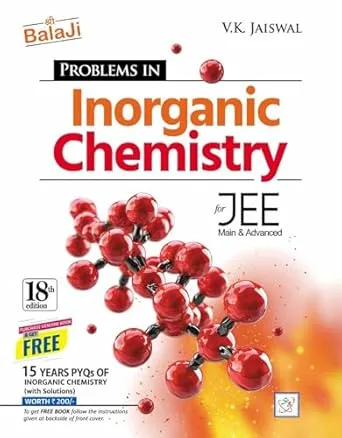
| Best practice book | V.K. Jaiswal, Problems in Inorganic Chemistry | Questions in levels | Main + Advanced |
| Theory for Advanced | J.D. Lee for JEE (Sudarsan Guha) | Theory with reasons | Advanced |
| Theory alternative | O.P. Tandon Inorganic Chemistry | Detailed theory | Main + Advanced |
One theory source and one problem book per branch, finished completely, beats five books started. So every pick below says what it is for, and when it is not worth buying.
The best inorganic chemistry books for JEE, explained
Which books should you use? Pick by your goal
JEE Main only
NCERT, read 3–4 timesthenV.K. Jaiswal Level 1thenJEE Main PYQs
In JEE Main 2026, p-block is only general trends of groups 13–18 and the only d-block compounds named are KMnO₄ and K₂Cr₂O₇. s-block and metallurgy are out.
Main + Advanced
NCERTthenJ.D. Lee for JEEthenV.K. Jaiswal, all levelsthenJEE Advanced PYQs
Keep s-block, hydrogen, metallurgy, detailed p-block compounds and qualitative analysis: JEE Advanced still asks them.
Self-study, no coaching
NCERTthenO.P. Tandon or J.D. Lee for JEEthenV.K. Jaiswal
Use the theory book to understand why; memorise from NCERT.
Dropper, 6–8 months left
NCERT, line by linethenV.K. JaiswalthenPYQs
Inorganic is the fastest area to improve in a short time if you revise a little every day.
What the 2026 syllabus changes for your books
The JEE Main 2026 syllabus (NTA) has 20 chemistry units and no longer includes states of matter, solid state, surface chemistry, s-block elements, hydrogen, metallurgy, polymers, environmental chemistry or chemistry in everyday life. Most books still print those chapters. If you are writing only JEE Main, skip them. JEE Advanced 2026 still includes all of them (its syllabus is unchanged from 2025), so Advanced aspirants should keep them.
The order to study inorganic chemistry
Periodic properties and chemical bonding come first, because they explain most trends you will otherwise have to memorise. Then coordination compounds (high-scoring and logical), d- and f-block, and p-block group by group.
For each chapter: read NCERT, read it again with a pencil, write the exceptions, colours and structures in a separate notebook, solve V.K. Jaiswal, then the PYQs. Revise the notebook a little every day: inorganic is less about understanding than about not forgetting.
Books you can skip
The original J.D. Lee (university edition) has much more than JEE needs; use the JEE adaptation instead. Huheey, Shriver & Atkins and Miessler & Tarr are university texts. Skipping NCERT for a bigger book costs more marks in JEE Main than anything else in chemistry.
Practise with real JEE papers
No book replaces past papers. Once a chapter is done, solve its questions from the official JEE Main 2026 papers and answer keys and, for Advanced, the official JEE Advanced papers 2015–2025. Also see the best organic chemistry book and best physical chemistry book guides, and all chemistry books for JEE.
How we chose these books
We matched each book against the official NTA JEE Main 2026 syllabus and the JEE Advanced 2026 syllabus, checked what students and teachers consistently recommend across forums and coaching advice, and confirmed the latest edition of each book on Amazon India on 24 October 2026. We don't rank books by commission; links to Amazon are affiliate links that support this free site at no cost to you.
Frequently Asked Questions about Inorganic Chemistry Books for JEE
Which is the best book for inorganic chemistry for JEE?
NCERT Class 11 and 12. Add V.K. Jaiswal's Problems in Inorganic Chemistry for practice, and Wiley's J.D. Lee for JEE (Sudarsan Guha) if you are preparing for JEE Advanced.
Is NCERT enough for inorganic chemistry in JEE Main?
For theory, almost entirely yes; JEE Main inorganic questions are built on NCERT text and tables. Add V.K. Jaiswal and past papers for practice.
Is NCERT enough for inorganic chemistry in JEE Advanced?
No. JEE Advanced also asks s-block, metallurgy, detailed p-block compounds and qualitative analysis in more depth. Use J.D. Lee for JEE and V.K. Jaiswal on top of NCERT.
J.D. Lee original or the Sudarsan Guha edition: which should I buy?
The Wiley edition adapted for JEE by Sudarsan Guha. The original J.D. Lee is a university textbook with a lot outside the JEE syllabus.
J.D. Lee or V.K. Jaiswal?
They do different jobs: J.D. Lee for JEE explains the theory, V.K. Jaiswal is a question bank. Advanced aspirants use both; JEE Main aspirants usually need only V.K. Jaiswal with NCERT.
Which inorganic chapters are not in JEE Main 2026?
s-block elements, hydrogen and metallurgy are not in the JEE Main 2026 syllabus, and p-block is limited to general trends of groups 13–18. JEE Advanced still includes them.
Support Our Mission
By purchasing through the links below, you help us keep JEE Archive running at no extra cost to you. We receive a small commission from amazon, which directly support the maintenance and growth of this platform.